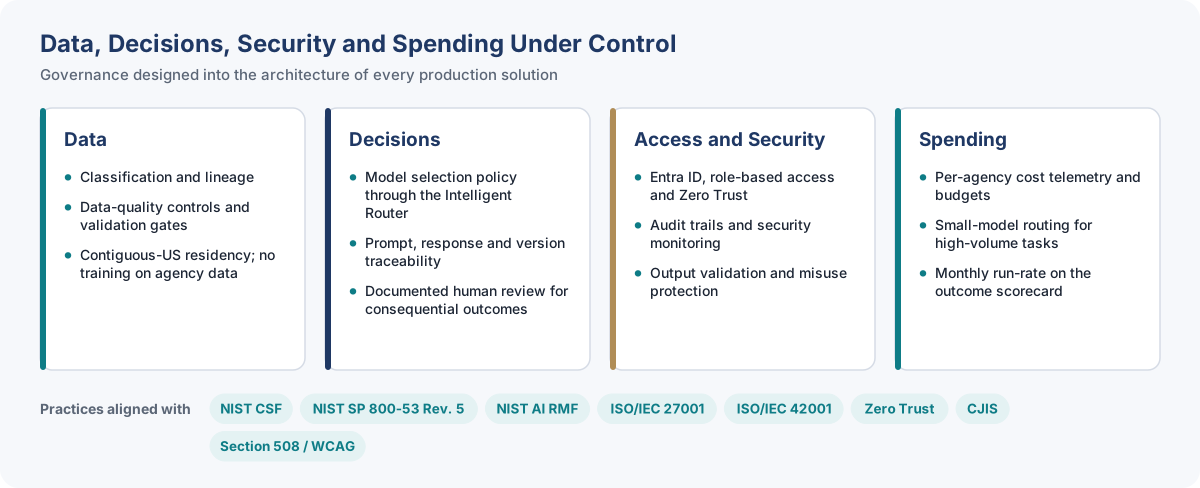
Data, decisions, security and spending under control
Governance is designed into the architecture. The evidence an agency needs is produced by the platform as it runs.
Four areas of control
Agencies see how each AI system is being used, what it is producing and whether it continues to perform as intended.
Nine controls across every layer
The governance and trust layer applies the following nine controls to every production solution.
- AI System Cards aligned to the NIST AI Risk Management Framework
- Classification and metadata tags
- End-to-end lineage
- Bias and fairness monitors
- Explainability and decision logs
- Human-in-the-loop approvals
- Prompt-injection and data-loss guardrails
- Immutable audit logs
- Model and version registry
AI System Cards
Every production AI component has an AI System Card: a plain-language record of what the system does, who owns it and how it is controlled. The example below is illustrative.
| Field | Example: Correspondence Drafting Assistant |
|---|---|
| Purpose | Drafts plain-language replies to resident inquiries for staff review |
| Risk tier | Medium: assistive, with no eligibility decisions |
| Data classification | Non-public; personal information masked before inference |
| Models | Small model for routing; larger model for drafting; US regions; no-training terms |
| Human oversight | Every draft reviewed and approved by staff before sending |
| Evaluation before release | Groundedness, accuracy, tone and bias results against an agency golden set |
| Monitoring | Accuracy, drift, override rate, complaints and cost, reviewed monthly |
| Change control | Model or provider changes need agency approval |
Requirements mapped to evidence
Public-sector AI policies ask for proof. The platform produces it automatically during delivery and operation.
| Requirement | Evidence AlgebraIT produces |
|---|---|
| Data use and model training | Signed data-use statement, zero-retention endpoint configuration, Router policy log |
| Bias protection | Slice metrics for each release; bias incident record with timestamps |
| Explainable and traceable | AI System Card, prompt and version registry, per-request decision trace |
| Continuous monitoring | Drift, accuracy and safety dashboards; periodic ethics report |
| Third-party disclosure | Model bill of materials; change request workflow in the registry |
| Classification and tagging | Labels applied at ingestion; tag completeness report |
| Data lineage | Automated lineage graph from source to output |
| Data return and destruction | Export package in open formats; destruction certificate |
Data residency and model terms
Contiguous-US boundary
Prompts, outputs, logs, backups and inference traffic remain in contiguous-US cloud regions, including disaster recovery.
No training on your data
Approved models run under no-training terms or are self-hosted.
You own your data and deliverables
Custom deliverables belong to the client, with open export formats and a documented transition plan.
Certifications and aligned frameworks
AlgebraIT holds ISO 9001, ISO/IEC 27001 and ISO/IEC 20000-1 certifications, as applicable to the certified scope.
Delivery practices align with the NIST Cybersecurity Framework, NIST SP 800-53 Rev. 5, the NIST AI Risk Management Framework, ISO/IEC 42001, Zero Trust principles, CJIS requirements, and Section 508 and WCAG accessibility requirements, selected according to the specific agency and system.
Share your AI policy with us
We will show how each requirement maps to a control and a piece of evidence.