One governed platform under every engagement
ADAP, the AI Microservices Stack and the Intelligent Router give each client a hardened starting point with governance built in.
Reference architecture
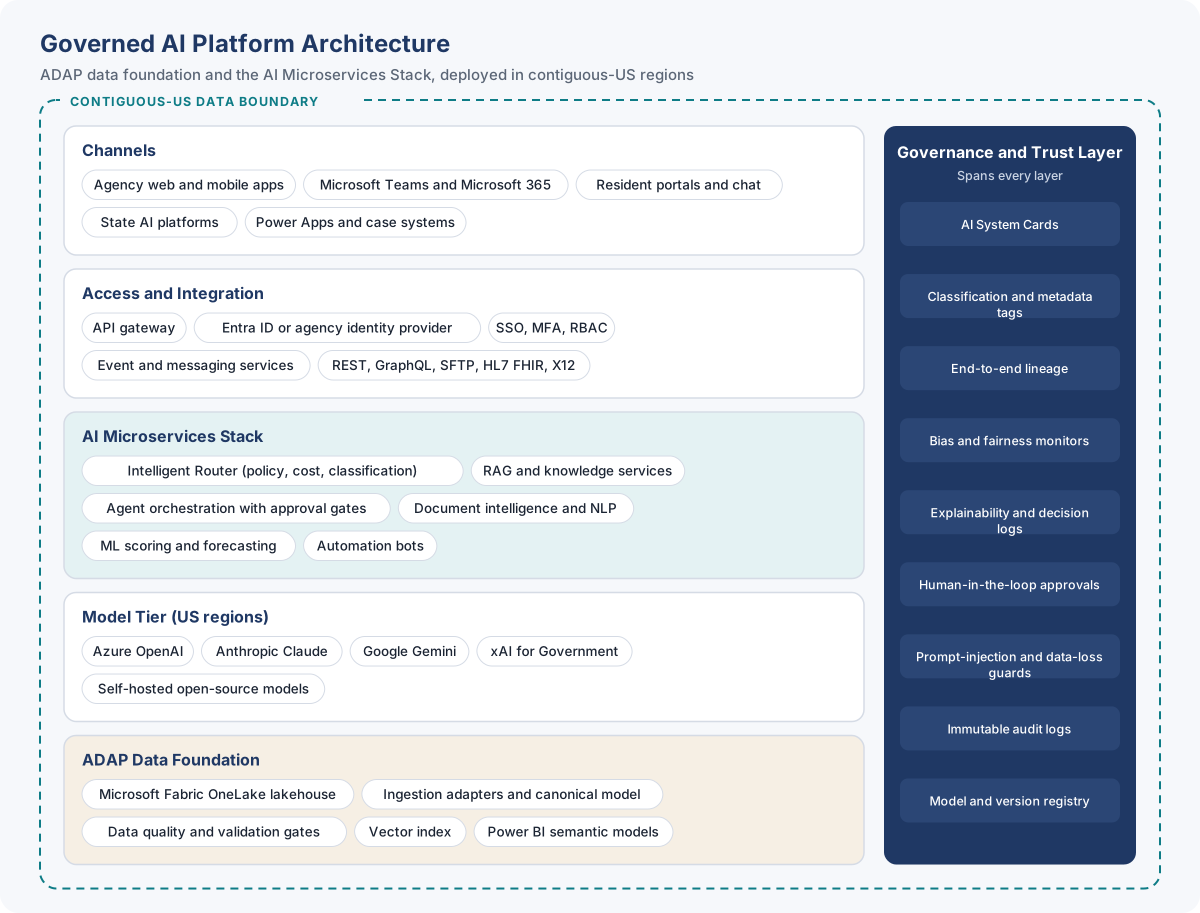
The platform runs entirely inside a contiguous-US boundary for primary and disaster recovery regions. Solutions reach users where they work, connect to source systems through standard interfaces, and draw on approved models under no-training terms.
ADAP Data Foundation
ADAP is AlgebraIT’s AI-enabled Data Access Platform. It brings data from many source systems into one governed foundation.
ADAP includes the following five components.
- 01 Microsoft Fabric OneLake lakehouse for structured and unstructured data
- 02 Ingestion adapters and a canonical model that standardize data from each source
- 03 Data quality and validation gates with thresholds agreed for each dataset
- 04 Vector indexes that make agency content searchable for AI assistants
- 05 Power BI semantic models for dashboards and the outcome scorecard
AI Microservices Stack
The AI Microservices Stack is a set of reusable services. New use cases are assembled from proven components, which shortens delivery and keeps behavior consistent across solutions.
Retrieval and knowledge services
Ground answers in agency content and return citations.
Agent orchestration
Run multi-step tasks with policy-bound tools and approval gates.
Document intelligence and NLP
Classify, extract, summarize and translate.
ML scoring and forecasting
Serve models for risk scoring, forecasting and anomaly detection.
Automation services
Connect AI outputs to workflows and systems of record.
Speech and vision services
Transcribe calls and read forms, images and handwriting.
Intelligent Router
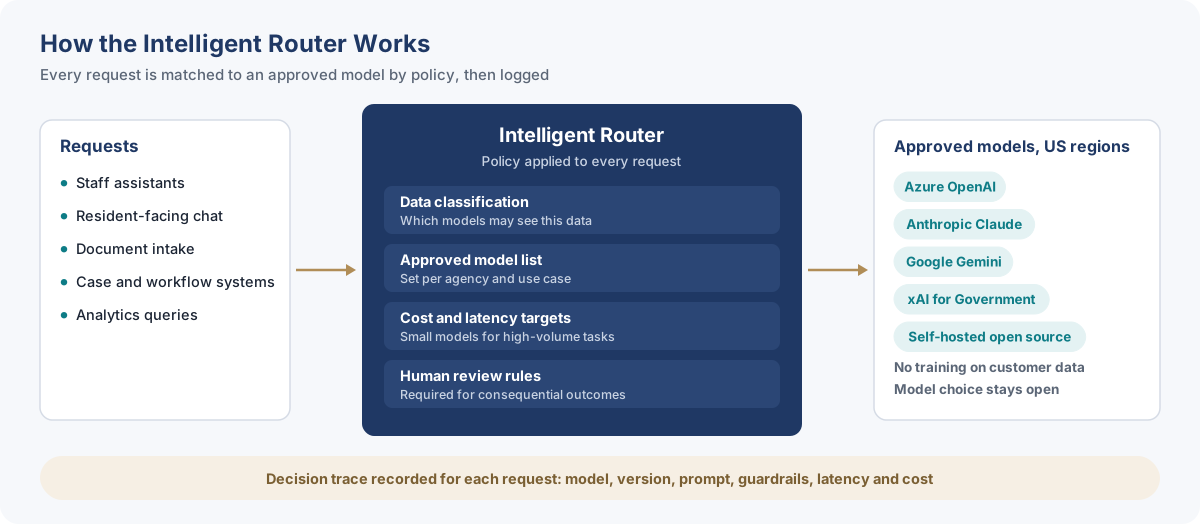
The Intelligent Router applies policy to every request and sends it to the right model. Agencies set the data classification rules, the approved model list, and the cost and latency targets. Small models handle high-volume tasks, and larger models are used where the work requires them.
Because the Router works across model families, an agency keeps its options open as models and prices change.
The platform in operation
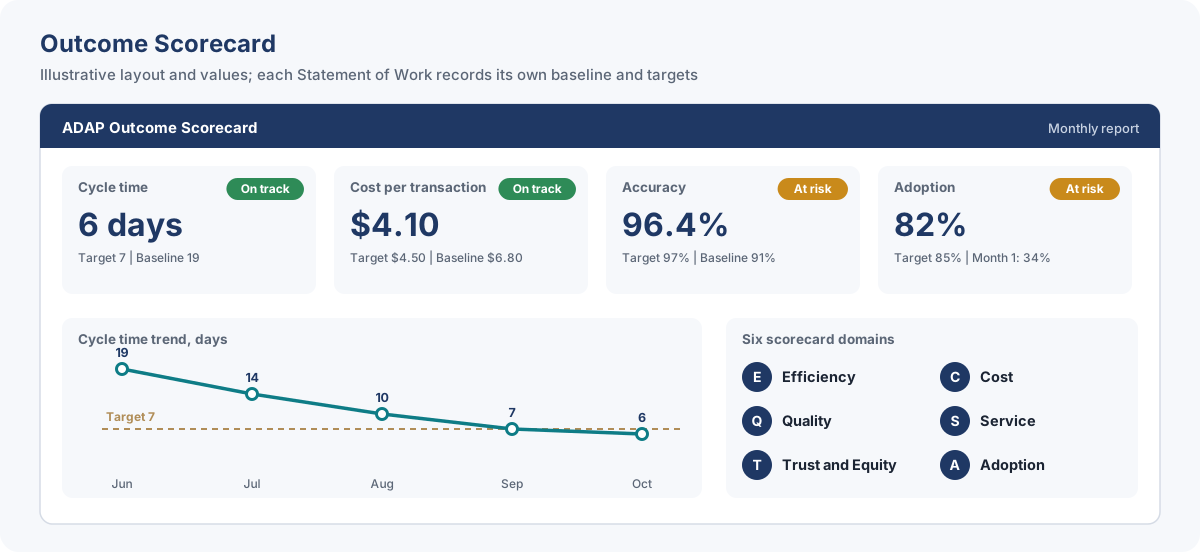
Two screens give agencies day-to-day visibility. The outcome scorecard dashboard shows cycle time, cost per transaction, accuracy and adoption against baseline and target. The Router decision-trace console shows the routing policy and, for each request, the model, version, guardrail result and latency.
Two platform principles
Customer data stays out of model training
Enterprise agreements with model providers prohibit training on customer data.
Vendor neutral in solution selection
The Intelligent Router and our build-versus-reuse analysis keep choices tied to each client’s requirements.
See the platform against your requirements
We can walk your architecture and security teams through each layer.