From pilot to production, with a gate at every step
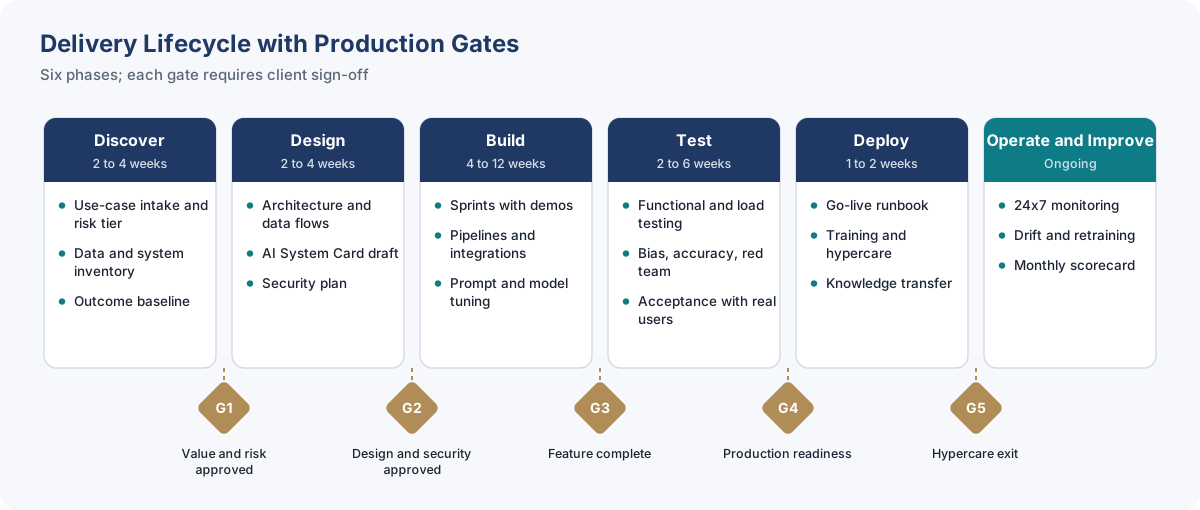
One method applies to every engagement: six phases, five signed gates, seven test layers and a scorecard that reports the outcome.
Delivery lifecycle with production gates
AlgebraIT closes the gap between an emerging-technology pilot and an enterprise service. Each gate requires client sign-off before work moves forward.
| Phase | Typical duration | What happens | Gate |
|---|---|---|---|
| Discover | 2 to 4 weeks | Mission, users, data, existing technology, constraints and the outcome baseline are established. | G1: Value and risk approved |
| Design | 2 to 4 weeks | Target architecture, integration approach, security controls, governance model and measurable outcomes are defined. | G2: Design and security approved |
| Build | 4 to 12 weeks | The solution is developed in sprints with demonstrations, pipelines, integrations and model tuning. | G3: Feature complete |
| Test | 2 to 6 weeks | Functional, data quality, security, performance, accessibility, model and user acceptance testing. | G4: Production readiness |
| Deploy | 1 to 2 weeks | Controlled release with a go-live runbook, training, hypercare and knowledge transfer. | G5: Hypercare exit |
| Operate and Improve | Ongoing | Performance, security, usage, data quality, cost and outcomes are monitored and improved. | Monthly scorecard |
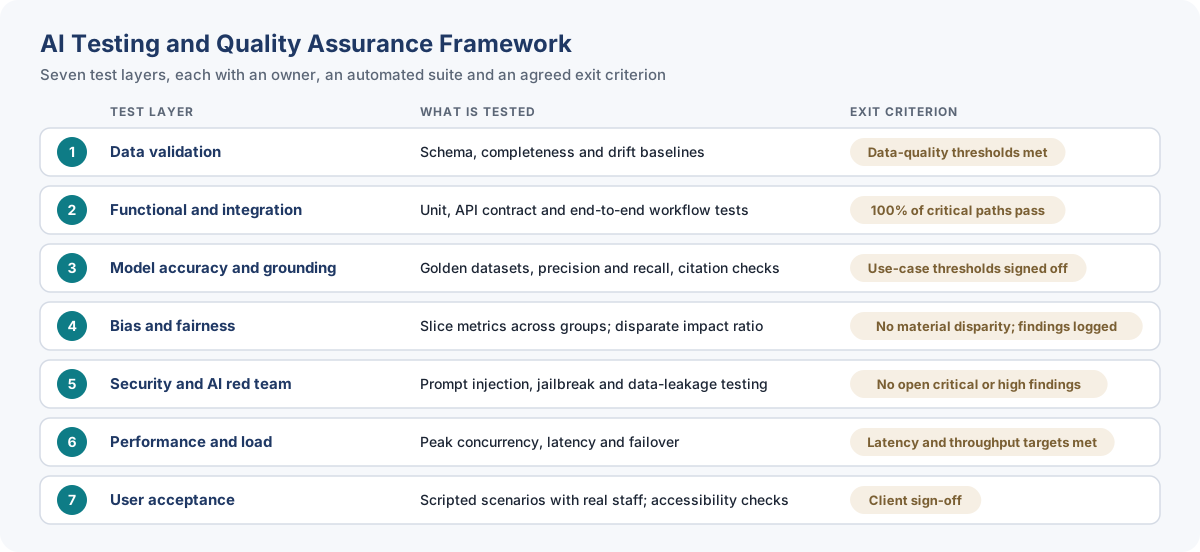
Seven-layer testing and quality assurance
AI systems need tests that conventional software does not. Each layer has an owner, an automated suite and an exit criterion agreed in the Statement of Work.
Every engagement is measured
The outcome scorecard is baselined in Discover, targeted in the Statement of Work, reported monthly and audited at closeout.
Efficiency
Cycle time per case, staff hours saved, backlog reduction.
Cost
Cost per transaction, run-rate against budget, payback period.
Quality
Accuracy and groundedness, data quality score, error and rework rate.
Service
Response time to the public, first-contact resolution, satisfaction.
Trust and Equity
Disparity ratio by group, human override rate, incidents and complaints.
Adoption
Active users, task completion rate, training completion.
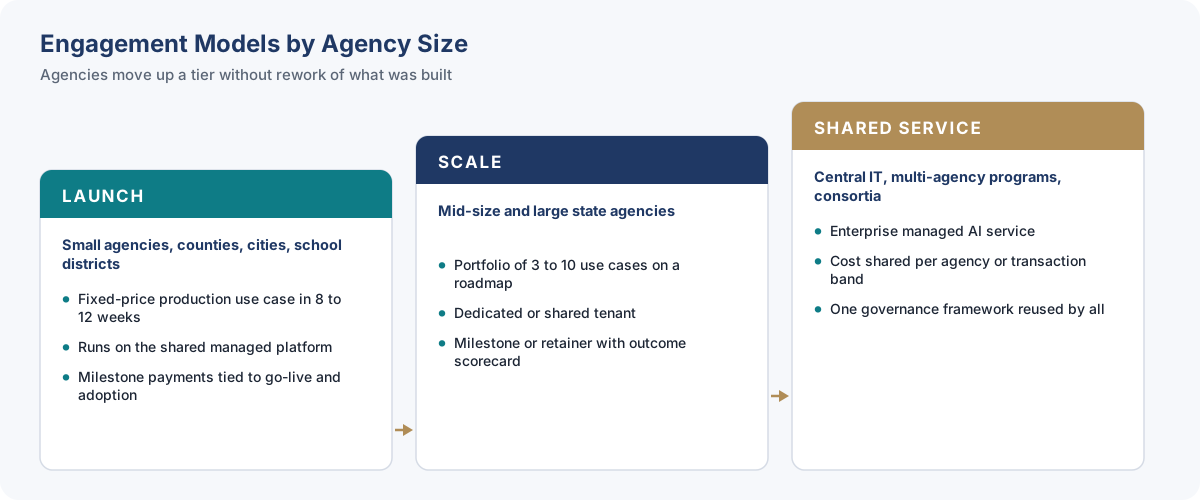
Engagement models sized to the agency
Three models keep each investment proportional to a proven business case. A smaller organization can begin with one focused use case and scale as value is demonstrated.
| Model | Best for | How it works |
|---|---|---|
| Launch | Small agencies, counties, cities, school districts | A fixed-price production use case in 8 to 12 weeks on the shared managed platform, with milestone payments tied to go-live and adoption. |
| Scale | Mid-size and large state agencies | A portfolio of 3 to 10 use cases on a roadmap, in a dedicated or shared tenant, with milestone or retainer pricing and an outcome scorecard. |
| Shared Service | Central IT, multi-agency programs, consortia | An enterprise managed AI service with cost shared per agency or transaction band, one governance framework and chargeback reports. |
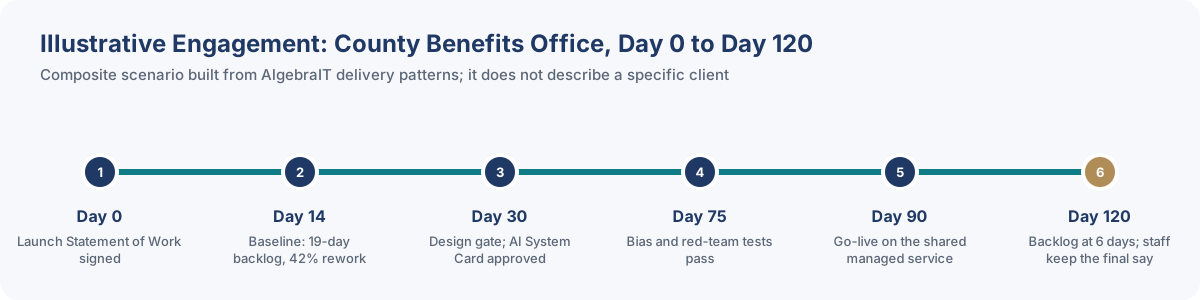
What a Launch engagement looks like
The timeline below is a composite scenario built from AlgebraIT delivery patterns. It shows how a county benefits office could move from a signed Statement of Work to a measured result in 120 days.
Bring us a pilot that needs to reach production
We assess the prototype, the data, the architecture and the security requirements, then set out a path with five signed gates.